
I. Statutory Foundation of Judgment Enforcement Thailand
1. Execution under the Thai Civil Procedure Code
Judgment enforcement in Thailand is governed by Book IV of the Civil Procedure Code (CPC), which regulates execution of final judgments and court orders.
Core legal principles include:
- A final judgment becomes enforceable once appeal periods lapse or appellate proceedings conclude.
- Execution must be initiated within the statutory limitation period prescribed under the CPC.
- The judgment creditor must apply for execution.
- Attachment and seizure are conducted under court supervision and implemented by the Legal Execution Department (LED).
Importantly, the CPC does not impose a general investigative obligation on the court to identify debtor assets on behalf of creditors. Execution is application-based and information-driven.
This structural characteristic directly influences recovery risk in Judgment Enforcement Thailand.
2. Separate Legal Personality (Civil and Commercial Code)
Under Section 1012 of the Civil and Commercial Code (CCC), a limited company becomes a juristic person distinct from its shareholders upon registration.
Legal implication:
- Corporate assets belong to the company.
- Shareholders’ creditors cannot directly attach corporate property.
- Creditors of one juristic entity cannot automatically enforce against related entities.
This statutory principle provides the legal basis for corporate layering strategies.
3. Mortgage Priority (Civil and Commercial Code)
Under Section 702 CCC, a mortgagee is entitled to receive payment from the mortgaged property in priority to unsecured creditors.
Implications for Judgment Enforcement Thailand:
- Even after seizure and auction, proceeds are distributed according to statutory priority.
- Secured claims reduce net recovery available to judgment creditors.
- Encumbrance layering materially affects enforcement outcomes.
4. Share Ownership and Registration
Under Section 1129 CCC, share ownership in a limited company is evidenced by entry in the shareholders’ register.
However:
- Registration reflects legal ownership.
- It does not necessarily reflect economic or operational control.
Therefore, nominee arrangements may exist without contradicting formal registry compliance.
5. Bankruptcy Act Interaction
Under the Bankruptcy Act B.E. 2483 (1940):
- Once the court issues an order of absolute receivership, individual enforcement actions may be restricted.
- Creditors must submit claims within the insolvency framework.
- Preferential transfers prior to bankruptcy may be subject to avoidance provisions.
Timing of execution is therefore legally significant.
II. Statutorily Contextualized Concealment Patterns
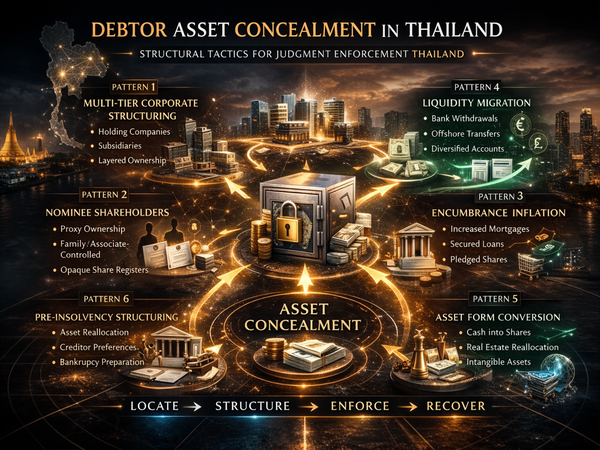
Pattern 1: Multi-Tier Corporate Structuring
Legal Basis:
- Section 1012 CCC (separate legal personality)
Mechanism:
- Asset-holding subsidiaries
- Operational companies separated from asset entities
- Family-controlled holding companies
Legal Character:
- Lawful corporate structuring
- Distinct juristic person protection
Enforcement Risk:
- Attachment limited to debtor entity assets
- Related-party assets insulated absent separate legal action
Pattern 2: Nominee Shareholding Structures
Legal Basis:
- Section 1129 CCC (share register governs legal ownership)
Mechanism:
- Shares registered in third-party names
- Control exercised through board appointments
- Informal governance influence
Legal Character:
- Registration compliant
- Control not automatically inferred from registry
Enforcement Risk:
- Share attachment may not disrupt operational authority
- Limited leverage despite legal seizure
Pattern 3: Encumbrance Inflation
Legal Basis:
- Section 702 CCC (mortgage priority)
- Relevant pledge provisions under CCC
Mechanism:
- Pre-enforcement mortgages
- Share pledges
- Secured related-party lending
Legal Character:
- Valid if properly registered
- Priority recognized by law
Enforcement Risk:
- Auction proceeds first satisfy secured creditors
- Judgment creditor may receive minimal balance
Pattern 4: Liquidity Migration
Legal Basis:
- CPC execution provisions require specific identification for attachment
Mechanism:
- Pre-attachment withdrawals
- Diversification across accounts
- Cross-border transfers
Legal Character:
- Lawful financial management unless fraudulent intent proven
Enforcement Risk:
- Delay reduces recoverable liquidity
- Execution timing becomes decisive
Pattern 5: Asset Form Conversion
Legal Basis:
- No prohibition under CCC against asset restructuring
- Corporate autonomy protected under company law
Mechanism:
- Conversion of cash to equity
- Transfer of personal property into corporate ownership
- Reclassification of asset types
Legal Character:
- Structurally lawful
- Economically dilutive
Enforcement Risk:
- Increased valuation complexity
- Reduced immediacy of seizure effectiveness
Pattern 6: Pre-Insolvency Structuring
Legal Basis:
- Bankruptcy Act avoidance and preference provisions
Mechanism:
- Accelerated repayment to selected creditors
- Secured structuring prior to petition
- Strategic asset repositioning
Legal Character:
- May be scrutinized under insolvency law
- Not automatically void
Enforcement Risk:
- Stay of individual execution
- Transition to collective insolvency regime
III. Legal-Strategic Implications for Judgment Enforcement Thailand
Statutory law provides procedural tools.
However, The interaction of these statutes creates structural complexity:
- The CPC enables attachment.
- The CCC protects secured priority.
- Company law protects separate personality.
- Bankruptcy law may suspend execution.
Judgment Enforcement Thailand is therefore not purely procedural since it is structurally contingent upon legal architecture.
IV. Academic Clarification
This analysis does not suggest that asset structuring equals illegality.
Rather:
- Thai law recognizes corporate autonomy.
- Secured transactions are lawful.
- Asset restructuring is permissible.
- Insolvency protection mechanisms are statutory.
The enforcement challenge lies in the lawful use of these structures to reduce asset accessibility.
Strategic intelligence operates within legal boundaries.
It anticipates structural positioning rather than alleging misconduct.
Conclusion
Under Thai law:
- Separate legal personality (CCC Section 1012)
- Mortgage priority (CCC Section 702)
- Share registration principles (CCC Section 1129)
- Execution rules under the Civil Procedure Code
- Insolvency effects under the Bankruptcy Act
collectively define the enforcement landscape.
Debtor asset concealment patterns in Thailand are frequently structural rather than fraudulent.
Effective Judgment Enforcement Thailand requires:
- Statutory literacy
- Structural analysis
- Encumbrance awareness
- Timing discipline
- Jurisdictional coordination
Legal entitlement establishes enforceability.
Structural intelligence determines realization.