
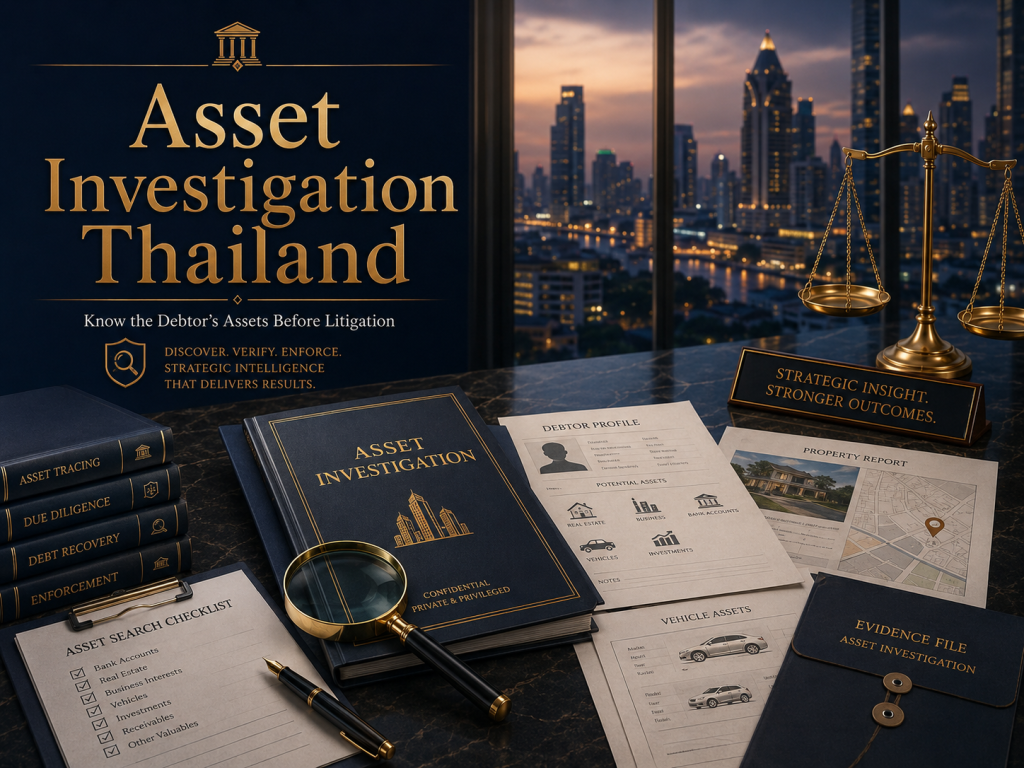
Asset Investigation Thailand: Why Foreign Creditors Should Search for Debtor Assets Before Litigation
Asset Investigation Thailand is a critical first step for foreign creditors who want to recover debt from a Thai company, individual, distributor, business partner, or judgment debtor. Before spending time and money on litigation, creditors should ask one practical question: if we win the case, can we actually recover the money?
In debt recovery matters, a strong legal claim does not always guarantee successful recovery. A creditor may have a signed contract, unpaid invoices, delivery records, payment reminders, and clear evidence of default. However, if the debtor has no identifiable assets, has transferred assets, operates through nominees, or hides business interests through related entities, litigation may result in a judgment that is difficult to enforce.
For this reason, asset investigation should not be treated as an afterthought. It should form part of the recovery strategy from the beginning. At Skyinterlegal, we assist foreign creditors with Debt Collection and Asset Recovery Services in Thailand, including debtor asset search, business verification, asset tracing, litigation support, and enforcement planning. Our investigation-based recovery approach helps creditors assess whether legal action is commercially worthwhile before committing significant legal costs.
What is asset investigation Thailand?
Asset investigation or asset search refers to the process of identifying and analyzing a debtor’s financial position, business operations, ownership structure, and potential recoverable assets before or during legal proceedings. The purpose is not only to understand whether the debtor owes money, but whether the debtor has the capacity or resources to satisfy a payment of debt.
Depending on the case, asset investigations may involve reviewing:
- Corporate registrations;
- Business activities;
- Shareholding structures;
- Director information;
- Property ownership;
- Vehicle ownership;
- Commercial operations;
- Related entities;
- Litigation history;
- Bankruptcy status;
- Financial behavior; and
- Physical business presence.
In commercial debt collection matters, information creates leverage. A creditor who understands the debtor’s operational and financial situation is often in a significantly stronger position during negotiations and litigation.
For more information, please see our service on Asset Search in Thailand.
Why asset investigation matters before debt recovery in Thailand?
1. A court judgment does not guarantee payment
One of the biggest misconceptions in cross-border debt recovery is that obtaining judgment automatically results in collection. In practice, enforcement is often the most difficult phase of the process.
If the debtor has no visible assets or transferred assets elsewhere, a successful lawsuit may have limited practical value. Thus, before initiating expensive litigation, creditors should understand whether meaningful recovery is realistically achievable. At Skyinterlegal, we believe this assessment should happen early for the best recovery.
2. Asset investigations help evaluate commercial risk
Not all unpaid debt should automatically proceed to litigation. In some cases, the debtor may genuinely be insolvent or the cost of litigation may exceed likely recovery. An early asset investigation helps foreign creditors make informed business decisions regarding whether:
- to pursue litigation;
- to negotiate settlement;
- an urgent action is needed; or
- recovery prospects are too limited.
Thus, asset investigation can save substantial time and legal costs.
3. Debtors may attempt to hide or move assets
In some commercial disputes, debtors attempt to avoid payment by moving assets to related companies, using nominee entities, or delaying communication while assets disappear. This is particularly important in international debt recovery matters where foreign creditors have limited visibility into local operations in Thailand.
Investigative work can help identify warning signs before formal enforcement becomes difficult. The earlier these issues are identified, the more effective options may remain available.
4. Asset information strengthens negotiation leverage
Debt recovery is not always about litigation. In many cases, strong negotiation pressure produces faster and more cost-effective results than formal court proceedings. When debtors realize that creditors possess accurate information regarding business operations, related entities, assets, directors, they often become more willing to negotiate seriously.
Information changes negotiating dynamics. This is one reason why investigative work can be highly valuable even before formal legal action begins.
Asset Investigation Thailand vs Ordinary Debt Collection
Ordinary debt collection may focus on reminders, demand letters, phone calls, negotiation, or payment follow-up. Asset investigation goes further by seeking to understand the debtor’s financial position, business activity, asset profile, and enforcement risk. This allows the creditor to make an informed decision before spending money on litigation.
A professional asset investigation may help answer the following questions:
- Is the debtor worth suing?
- Are there assets that may support enforcement?
- Is the debtor still operating?
- Has the debtor moved assets to another company?
- Are directors or shareholders using nominee structures?
- Is the debtor preparing to close or become dormant?
- Is settlement more realistic than litigation?
- Should the creditor act quickly to preserve recovery options?
This is where our firm’s approach stands apart. While many firms focus primarily on the legal aspects of debt collection, at Skyinterlegal, we emphasize investigation-based recovery, bridging the gap between having a legal claim and achieving actual recovery. Our background as a former investigative company allows us to assess debtors from both a legal and practical perspective, helping clients understand not only whether they can pursue a claim, but whether recovery is realistically achievable.
When should asset investigation be conducted?
Timing is extremely important in commercial debt recovery matters. Many creditors wait too long before taking action because they hope the debtor will voluntarily resolve the matter. Unfortunately, delays can significantly reduce recovery prospects.
Asset investigation is most useful before or when:
1. Filing a lawsuit
Before filing a lawsuit, creditors should assess whether the debtor has recoverable assets. This helps avoid spending legal fees on a claim that may be legally strong but commercially unrecoverable.
2. Sending a demand letter
A demand letter becomes more effective when the creditor understands the debtor’s business position and asset profile. If the creditor already knows that the debtor remains active or owns recoverable assets, negotiation pressure may increase.
3. Accepting a settlement proposal
Debtors sometimes offer long installment plans to buy time. Asset investigation can help creditors decide whether the proposal is genuine or simply a delay tactic.
4. Judgment enforcement
If the creditor already has a judgment, asset investigation becomes essential for enforcement planning.
5. Warning signs of asset concealment
If the debtor changes address, transfers business to another company, removes inventory, closes offices, or stops communicating, early asset investigation may help protect the creditor’s recovery position.
What are the key asset categories that can be investigated?
1. Real estate and land interests
Asset investigation may disclose whether the debtor owns any land, buildings, condominium units, and other property that may be held through related companies or nominees. Real estate information may help creditors assess whether litigation is worthwhile and whether enforcement is possible.
2. Vehicles, machinery, equipment, and inventory
Some debtors do not own land but may own valuable movable assets. These may include:
- cars;
- trucks;
- machinery;
- industrial equipment;
- office equipment;
- stock or inventory;
- production materials;
- tools;
- vessels or specialized commercial assets; and
- other business-related movable property.
For distributors, importers, manufacturers, logistics providers, and trading companies, inventory and equipment may be relevant to recovery strategy.
3. Business interests and shareholdings
A debtor may appear to have limited personal or direct assets while still controlling valuable business interests. Asset investigation may review:
- company shareholding;
- directorships;
- related entities;
- group structures;
- affiliated businesses;
- nominee shareholder arrangements;
- changes in company ownership;
- newly established companies;
- business transfers; and
- revenue-generating operations.
This is particularly important when the debtor has moved operations from one legal entity to another.
4. Nominee risks and related-party structures
Foreign creditors often face difficulty when assets do not appear directly under the debtor’s name.
In some cases, a debtor may use relatives, nominee shareholders, affiliated companies, or shell entities to conceal the asset. A proper asset investigation can identify red flags and help counsel consider whether further legal action, evidence preservation, or strategic negotiation is appropriate.
Practical Checklist for Foreign Creditors
Before instructing asset investigation in Thailand, foreign creditors should prepare:
1. Debtor information, including:
- Thai company name
- Registration number
- Registered address
- Operating address
- Director names
- Contact persons
- Known related companies
- Known business locations
2. Related documents, including:
- Contract
- Invoice
- Purchase order
- Delivery record
- Service completion record
- Payment reminders
- Debtor acknowledgements
- Settlement discussions
- Legal notices
The more information the creditor provides, the more focused and cost-effective the investigation can become.
What are the common mistakes creditors make before debt recovery?
In cross-border commercial disputes, especially in Thailand, many foreign creditors delay or unintentionally weaken their own recovery position long before formal legal action begins. While the debt itself may be valid and well documented, the way a creditor handles the early stages often has a significant impact on whether recovery is ultimately successful. Below are the common mistakes creditors make before debt recovery:
- Filing a lawsuit without checking assets;
- Waiting until after judgment to search for assets;
- Relying only on the debtor’s promises;
- Accepting weak installment plans; and
- Ignoring related companies; and
- Treating debt recovery as a purely legal process.
Why foreign creditors choose us for Asset Investigation Thailand?
At Skyinterlegal, we go beyond a purely legal assessment of a debt claim and focus on what truly matters in practice — whether the debt can actually be recovered. While many firms concentrate on establishing legal liability, we place equal emphasis on identifying the debtor’s real financial position, operational status, and available assets before recommending any legal action.
Our approach is rooted in investigation-based recovery. Before becoming a law firm, we operated as an investigative company, and that experience continues to shape how we work today. We combine legal analysis with practical asset tracing, including reviewing corporate structures, identifying related companies, and assessing whether assets may be held indirectly through affiliates or nominee arrangements. This allows us to provide clients with a clearer and more realistic view of recovery prospects.
As a result, foreign creditors are able to make more informed decisions from the outset, whether to proceed with litigation, pursue settlement, or reassess recovery strategy. By bridging the gap between legal rights and enforceable outcomes, we help ensure that debt recovery efforts in Thailand are not only legally sound, but commercially effective.
Contact Us
If you are considering debt recovery, litigation, settlement negotiation, or judgment enforcement against a Thai debtor, asset investigation should be part of your strategy from the beginning.
At Skyinterlegal, we assist foreign creditors with debtor asset checks, business verification, nominee risk analysis, asset transfer review, litigation support, and enforcement planning. For a broader investigation service, please see our related debtor search service.
Our Debt Collection and Asset Recovery Services in Thailand help foreign creditors evaluate recovery prospects before committing to costly litigation or enforcement action.
Contact us today for a confidential assessment of your debtor’s asset profile and recovery prospects before committing to litigation in Thailand.

Frequently Asked Questions
Asset investigation does not always lead directly to litigation. In many cases, it improves negotiation. When a creditor understands the debtor’s business and asset position, it can negotiate from a stronger position.
Litigation involves time, cost, uncertainty, and enforcement risk. Asset investigation helps reduce these risks by allowing creditors to assess whether the debtor is worth suing, whether recovery is realistic; and whether urgent action is needed.
Creditors should conduct asset investigation before litigation because winning a judgment does not guarantee recovery. If the debtor has no reachable assets, litigation may become costly and ineffective.
Debtor asset search Thailand refers to checking whether a Thai debtor has assets such as real estate, vehicles, business interests, receivables, inventory, equipment, or other recoverable assets that may support settlement or enforcement. For many foreign creditors, our service on Asset Search in Thailand can provide useful information before deciding whether to negotiate, sue, or prepare for enforcement.
Yes, asset investigation can strengthen a creditor’s position before sending a demand letter by helping the creditor understand whether the debtor is active, financially capable, or likely to respond to legal pressure.
Generally, asset investigation may cover real estate, vehicles, business interests, company shareholding, operating premises, inventory, machinery, related companies, nominee risks, asset transfers, and other financial indicators, depending on the case.
At Skyinterlegal, we can assist with reviewing indicators of asset transfer, related-party movement, nominee structures, changes in business ownership, director changes, shareholder changes, and other red flags relevant to recovery strategy.
Yes, asset investigation is also useful after judgment because enforcement requires identifying assets that may be seized, attached, or otherwise used to satisfy the judgment.
No, asset investigation does not guarantee recovery. However, it helps creditors make informed decisions, avoid unnecessary litigation, identify recovery targets, and design a more practical legal strategy.
A foreign creditor should start asset investigation as early as possible, especially before litigation, before accepting a settlement proposal, or when the debtor shows signs of delay, concealment, restructuring, or asset transfer.
For more inquiries, please feel free to contact us:
Sky International Legal Co., Ltd.
725 S Metro Building, 20th Floor, Room 174, Sukhumvit Road, Khlong Tan Nuea Subdistrict, Vadhana District, Bangkok 10110.
See map (click here)
Tel. 081-9151522, 090-0700080
Email: skyinterlegal@gmail.com