

Commercial Litigation in Thailand
Commercial Litigation Thailand is essential for companies, foreign investors, creditors, exporters, importers, contractors, distributors, service providers, SaaS and IT businesses, and cross-border commercial partners involved in business disputes in Thailand. In many cases, commercial disputes involve contracts, payments, company relationships, supply chains, business misconduct, shareholder conflicts, or failed commercial transactions.
At Skyinterlegal, we provide commercial litigation support for businesses and foreign clients who need to protect legal rights, resolve disputes, recover losses, or pursue claims through the Thai legal system. Our approach combines legal analysis, evidence review, commercial risk assessment, negotiation strategy, asset intelligence, and enforcement planning.
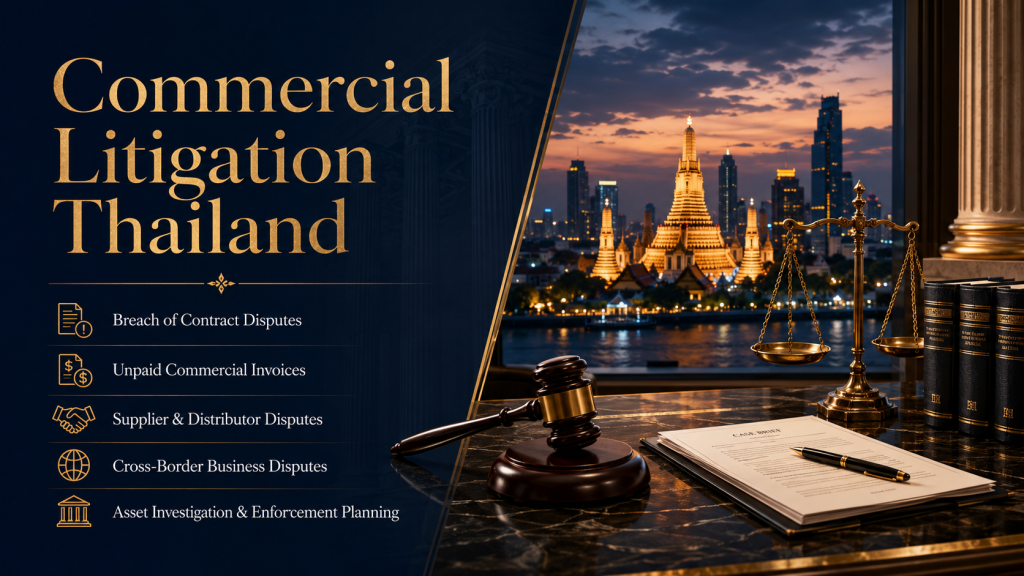
Commercial Litigation Thailand for Foreign Companies and Investors
Foreign companies and investors often face complex challenges when commercial disputes arise in Thailand. A dispute may involve a Thai company, local supplier, distributor, customer, contractor, business partner, shareholder, director, debtor, or service provider.
At Skyinterlegal, we assist foreign clients with Commercial Litigation Thailand by reviewing the facts, assessing the legal basis of the claim, identifying evidence, evaluating commercial risks, and preparing a practical litigation strategy. We help clients understand not only whether they can file a claim, but also whether the dispute is worth pursuing from a cost, risk, and recovery perspective.
Our commercial litigation services are suitable for:
- Foreign companies doing business in Thailand;
- International creditors;
- Exporters and importers;
- SaaS and technology companies;
- Contractors and service providers;
- Distributors and suppliers;
- Joint venture partners;
- Foreign investors;
- Cross-border businesses; and
- Overseas law firms requiring Thailand support.
We provide clear communication in English and help foreign clients understand Thai legal procedures, documentary requirements, court strategy, settlement options, and enforcement considerations.
Commercial Litigation Thailand for Business Disputes
Commercial disputes can arise at any stage of a business relationship. Some disputes result from clear breach of contract. Others involve unclear documentation, business misconduct, unpaid invoices, supply chain failures, shareholder conflicts, or hidden asset problems.
At Skyinterlegal, we assist clients with a wide range of commercial disputes in Thailand, including;
1. Breach of contract disputes
Breach of contract disputes are among the most common commercial litigation matters in Thailand. These disputes may involve failure to perform contractual obligations, refusal to pay, delayed delivery, defective goods or services, improper termination, or disagreement over contractual terms. At Skyinterlegal, we assist clients with contract review, breach assessment, evidence preparation, negotiation, demand letters, litigation planning, and enforcement strategy.
2. Unpaid commercial invoices
Unpaid invoices can create serious cash flow and recovery problems for foreign companies, exporters, suppliers, service providers, and contractors. In some cases, the debtor may dispute the invoice, delay payment, ignore reminders, close operations, or transfer assets.
Before filing a lawsuit, creditors may consider our Debt Collection and Asset Recovery Services in Thailand to assess whether negotiation, demand letters, debtor tracing, or asset recovery measures should be attempted first. Where formal legal action becomes necessary, commercial litigation may help creditors pursue unpaid invoices through Thai court proceedings.
3. Supplier and distributor disputes
Supplier and distributor disputes may involve non-payment, failure to deliver goods, defective products, unauthorized sales, termination issues, breach of exclusivity, pricing disputes, warranty claims, or failure to meet commercial obligations.
At Skyinterlegal, we assist clients with reviewing agreements, correspondence, purchase orders, delivery records, invoices, payment history, and evidence of breach. We help clients assess whether negotiation, settlement, litigation, or enforcement action is the most suitable approach.
4. Partnership and business cooperation disputes
Business cooperation disputes may arise when parties disagree over profit sharing, responsibilities, performance standards, investment contributions, management authority, or termination of cooperation. These disputes often involve both legal and factual issues. We help clients review the business structure, available documents, financial records, communications, and conduct of the parties before preparing a strategy.
5. Joint venture disputes
Joint venture disputes can be highly sensitive, especially where foreign investors rely on local partners, directors, shareholders, or business representatives in Thailand. These disputes may involve company control, profit distribution, unauthorized transactions, misuse of funds, shareholder deadlock, or breach of investment terms.
At Skyinterlegal, we assist clients with legal assessment, corporate document review, evidence preparation, negotiation strategy, and litigation planning. Where factual verification is required, clients may also consider our Thailand Investigation Services to review company information, business activity, asset indicators, and potential misconduct.
6. Service agreement disputes
Service agreement disputes may involve failure to deliver services, poor performance, scope disagreements, delayed work, termination issues, unpaid service fees, software implementation problems, consulting disputes, or outsourced service conflicts. These disputes are common in professional services, IT, SaaS, digital services, consulting, construction-related services, logistics, marketing, and business support arrangements. At Skyinterlegal, we help clients review the service agreement, statement of work, payment records, deliverables, communications, and evidence of performance or non-performance.
7. Commercial fraud claims
Commercial fraud may involve false representations, forged documents, misuse of company funds, fake invoices, dishonest business partners, investment fraud, unauthorized transactions, or deceptive business conduct.
Fraud-related commercial litigation often requires careful coordination between evidence review, factual investigation, civil claims, criminal complaint strategy, asset tracing, and recovery planning. At Skyinterlegal, we assist clients with structured case assessment and practical recovery strategy.
8. Business tort claims
Business tort claims may arise from wrongful conduct that causes commercial loss, such as misrepresentation, unlawful interference, misuse of confidential information, negligent conduct, unfair business conduct, or other civil wrongs affecting business interests. These claims require careful evidence preparation.
What is commercial litigation process in Thailand?
The commercial litigation process in Thailand depends on the type of claim, the contract terms, the parties involved, the court’s jurisdiction, the evidence, and the conduct of the opposing party. Although each dispute differs, our commercial litigation process generally involve the following stages.
1. Commercial case assessment
The first stage is to assess the facts, legal basis, documents, commercial objectives, limitation period, opponent profile, potential damages, and recovery options. This stage helps determine whether the client should proceed with negotiation, mediation, arbitration, litigation, or a combined strategy.
2. Evidence review and document preparation
Commercial disputes usually depend heavily on documents. Important evidence may include contracts, invoices, purchase orders, delivery records, service reports, emails, chat messages, accounting records, bank transfers, company records, board resolutions, and witness information. At Skyinterlegal, we help clients identify key documents, organize evidence, and assess weaknesses before legal action begins.
3. Demand letter and pre-litigation negotiation
A demand letter may help clarify the claim, create settlement pressure, and establish a written record before litigation. However, the timing and content of the demand letter should be planned carefully, especially where there is a risk that the debtor or opposing party may transfer assets or destroy evidence. At Skyinterlegal, we assist with pre-litigation negotiation and settlement strategy where appropriate.
4. Settlement strategy
Many commercial disputes can be resolved through settlement if the parties understand their legal risks and commercial interests. A well-structured settlement may reduce time, cost, uncertainty, and enforcement risk. However, settlement agreements should be drafted carefully as a weak settlement structure may create further problems if the opposing party fails to comply.
5. Filing a commercial lawsuit
If negotiation fails, the claimant may proceed with filing a lawsuit before the competent Thai court. The litigation process in Thailand may involve court pleadings, hearings, submission of documentary evidence, witness testimony, expert evidence where appropriate, and the issuance of a court judgment.
6. Judgment enforcement and recovery planning
Winning a commercial case does not guarantee recovery. If the losing party does not voluntarily comply with the judgment, enforcement may be required. Clients who already have a judgment or need post-judgment recovery support may review our Enforcement of Judgments and Asset Investigation in Thailand service for judgment enforcement strategy, asset investigation, and lawful execution support.
Litigation Strategy with Asset Investigation
A commercial claim should be evaluated not only on its legal merits, but also from an enforcement and recovery perspective. Even where a company has a strong contractual position, clear supporting documentation, and a valid legal claim, recovery may still be challenging if the opposing party lacks identifiable assets or has transferred assets prior to enforcement proceedings.
Our approach to Commercial Litigation Thailand combines litigation strategy with asset intelligence and practical recovery planning. This helps clients understand whether litigation is commercially sensible before spending substantial legal costs. Where asset visibility is important, clients may consider an Asset Search in Thailand before or during litigation.
This is because asset investigation may help assess:
- Whether the opposing party has identifiable assets;
- Whether a debtor company is still operating;
- Whether assets may support enforcement after judgment;
- Whether property, vehicles, shares, bank indicators, or business assets may exist;
- Whether the opposing party has transferred or concealed assets;
- Whether settlement pressure can be improved; and
- Whether litigation is commercially practical.
This approach is especially important for debt claims, commercial fraud, shareholder disputes, unpaid invoices, and cross-border business disputes.
Cross-Border Commercial Litigation in Thailand
Many commercial disputes involving Thailand have an international element. A foreign company may have a Thai debtor, a Thai supplier, a Thai distributor, a Thai customer, a Thai joint venture partner, or assets located in Thailand. At Skyinterlegal, we support foreign clients and overseas counsel with cross-border commercial litigation involving Thailand. We assist with local legal procedures, evidence review, document coordination, investigation support, settlement strategy, asset search, and enforcement planning.
Cross-border commercial disputes may involve:
- Foreign company claims against Thai companies;
- Thai debtor disputes;
- Export and import payment claims;
- Distributor and supplier conflicts;
- International service agreement disputes;
- Joint venture disputes involving Thai parties;
- Evidence or witnesses located in Thailand;
- Assets located in Thailand; and
- Coordination with overseas lawyers.
For foreign companies, commercial litigation in Thailand requires both legal knowledge and practical local understanding. That is why we help clients navigate these issues with structured guidance and clear communication.
Commercial Litigation, Mediation, and Arbitration
Not every commercial dispute should proceed directly to court litigation. In some cases, negotiation, mediation, conciliation, or arbitration may offer a more efficient path. Commercial contracts may contain dispute resolution clauses that require arbitration or specify a method of settlement before court proceedings. For cross-border contracts, arbitration may be especially relevant.
At Skyinterlegal, we also assist clients in assessing whether litigation, mediation, arbitration, or settlement negotiation is the most appropriate option. Clients who wish to explore non-court dispute resolution may review our Alternative Dispute Resolution in Thailand service.
Our support may include:
- Reviewing dispute resolution clauses;
- Assessing court or arbitration options;
- Preparing settlement strategy;
- Supporting negotiation or mediation;
- Reviewing settlement terms; and
- Planning enforcement of settlement terms or awards.
This is because a well-planned dispute resolution strategy can reduce unnecessary cost and improve the chance of a practical outcome.
Why Choose Skyinterlegal for Commercial Litigation Thailand
At Skyinterlegal, we provide professional Commercial Litigation services in Thailand with a strong emphasis on practical business outcomes. Our approach goes beyond legal analysis by focusing on clear litigation strategy, evidence-based assessment, cost and risk evaluation, and effective recovery planning tailored to each dispute.
Our litigation team is trusted for:
- Clear legal assessment before litigation;
- Asset intelligence and debtor background review;
- Pre-litigation negotiation and settlement strategy;
- Coordination between litigation and enforcement;
- Professional communication in English for foreign clients;
- Commercial risk and recovery analysis;
- Evidence-focused case preparation; and
- Comprehensive supporting services to facilitate legal proceedings and cross-border transactions, including notarization and translation service, legalization support, asset investigation service, and enforcement planning.
With experience in legal services, investigation, asset search, debtor tracing, and enforcement support, Skyinterlegal approaches commercial disputes from both legal and factual perspectives.
For clients who need broader dispute support, please refer to our page on Litigation Services in Thailand.
Contact Us for Commercial Litigation Thailand
Commercial disputes in Thailand require careful legal analysis, practical strategy, and a clear understanding of recovery risks. At Skyinterlegal, we advise businesses and international clients on a wide range of commercial litigation matters in Thailand, including contract disputes, unpaid debts, shareholder conflicts, and enforcement proceedings. We work closely with clients to develop effective dispute resolution strategies aligned with their commercial objectives and legal position.
Contact us today to discuss your matter confidentially and learn how we can assist with your dispute.

FAQ on Commercial Litigation Thailand
What is commercial litigation in Thailand?
Commercial Litigation Thailand refers to legal proceedings involving business disputes in Thailand. These disputes may involve contracts, unpaid invoices, suppliers, distributors, shareholders, joint ventures, service agreements, commercial fraud, business torts, or cross-border commercial claims.
Who may need commercial litigation services in Thailand?
Commercial litigation services may be useful for foreign companies, Thai companies, investors, creditors, exporters, importers, contractors, distributors, service providers, SaaS and IT companies, joint venture partners, and overseas law firms handling Thailand-related disputes.
Can a foreign company sue a Thai company in Thailand?
Yes, a foreign company may bring a claim in Thailand if the Thai court has jurisdiction and the claim has a valid legal basis. The required documents, translations, evidence, and procedural steps depend on the nature of the dispute.
What types of business disputes can you assist with?
At Skyinterlegal, we assist with breach of contract disputes, unpaid commercial invoices, supplier and distributor disputes, service agreement disputes, shareholder conflicts, joint venture disputes, commercial fraud claims, business tort claims, and cross-border commercial disputes.
Should a business send a demand letter before filing a lawsuit?
A demand letter may help clarify the claim, encourage settlement, and create a written record before litigation. However, it may not be suitable in every case, especially where there is urgency, risk of asset transfer, or concern that the opposing party may conceal evidence or assets.
What documents are important in commercial litigation?
Important documents may include contracts, invoices, purchase orders, delivery records, service reports, payment records, bank transfers, emails, chat messages, company documents, board resolutions, accounting records, and evidence showing breach, loss, or damage.
How long does commercial litigation in Thailand take?
The timeline depends on the complexity of the dispute, court schedule, evidence, witnesses, settlement attempts, appeals, and the conduct of the parties. Some commercial disputes may resolve through negotiation within weeks or months, while full litigation may take significantly longer.
Can commercial litigation help recover unpaid invoices in Thailand?
Yes, commercial litigation may help creditors pursue unpaid invoices through Thai court proceedings. However, creditors should also assess whether the debtor has assets that may support enforcement after judgment.
Why is asset investigation important in commercial litigation?
Asset investigation helps assess whether the opposing party has identifiable assets that may support recovery. Without asset visibility, a claimant may win a judgment but still face difficulty collecting money through enforcement. Where asset visibility is important, clients may consider our Asset Search in Thailand service before or during litigation.
Can commercial disputes be resolved without going to court?
Yes, some commercial disputes may be resolved through negotiation, mediation, conciliation, arbitration, or structured settlement. The best option depends on the contract, evidence, urgency, commercial relationship, and recovery objectives.
Clients may review our Alternative Dispute Resolution in Thailand service for non-court dispute resolution options.
Do you assist with commercial fraud claims?
Yes, we assist with commercial fraud matters involving misrepresentation, fake invoices, misuse of funds, dishonest business conduct, unauthorized transactions, and related recovery strategy. These cases often require both legal assessment and factual investigation.
Where facts, parties, assets, or business activity must be verified, our Thailand Investigation Services may support the litigation strategy.
What happens after winning a commercial case in Thailand?
If the losing party complies with the judgment, the matter may conclude through payment or performance. If the losing party does not comply, the successful claimant may need to proceed with judgment enforcement through the relevant legal execution process.
Clients who need post-judgment support may review our Enforcement of Judgments and Asset Investigation in Thailand service.
Do you support foreign law firms with Thailand-related commercial disputes?
Yes, we also support foreign law firms, overseas counsel, creditors, companies, and investors that need local legal support, evidence review, investigation, asset search, negotiation support, or enforcement planning in Thailand.
For more inquiries, please feel free to contact us:
Sky International Legal Co., Ltd.
725 S Metro Building, 20th Floor, Room 174, Sukhumvit Road, Khlong Tan Nuea Subdistrict, Vadhana District, Bangkok 10110.
See map (click here)
Tel. 081-9151522, 090-0700080
Email: skyinterlegal@gmail.com