

Debt Recovery Litigation in Thailand
Debt Recovery Litigation Thailand is a legal process for creditors, foreign companies, investors, lenders, exporters, suppliers, and business operators who need to take formal legal action against debtors in Thailand. In practice, debt disputes may involve unpaid invoices, loan defaults, breached payment terms, commercial debts, personal debts, company debtors, or Thai businesses that refuse to pay.
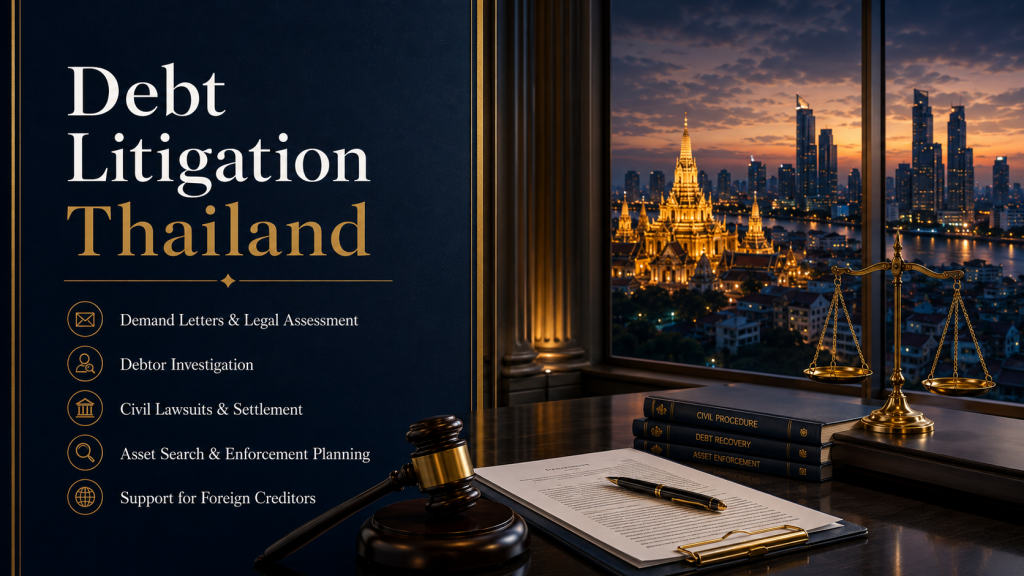
At Skyinterlegal, we assist creditors with Debt Recovery Litigation strategy, legal claim assessment, demand letters, debtor investigation, evidence review, settlement negotiation, civil lawsuits, and enforcement planning. Our approach focuses not only on filing a lawsuit, but also on assessing whether the debtor has assets or recovery potential before substantial legal costs are spent.
In many cases, the real objective is not only to win a judgment, but to recover money through settlement, enforcement, or practical legal pressure.
Debt Recovery Litigation Thailand for Foreign Creditors
Foreign creditors often face practical difficulties when trying to recover debt from debtors in Thailand. These difficulties may include language barriers, unfamiliar legal procedures, incomplete debtor information, unclear company status, limited asset visibility, and uncertainty about how Thai court judgments are enforced.
At Skyinterlegal, we provide professional Debt Recovery Litigation services in Thailand for foreign creditors who need to sue debtors, recover unpaid invoices, enforce loan agreements, or pursue legal claims against Thai companies or individuals. We assist clients by reviewing the debt evidence, identifying the legal basis of the claim, assessing the debtor’s profile, preparing litigation strategy, and explaining the practical recovery options before court proceedings begin.
Our Debt Recovery Litigation services are suitable for:
- Foreign creditors;
- Exporters and suppliers;
- International companies;
- Lenders and private creditors;
- Contractors and service providers;
- Investors with unpaid claims;
- Companies with unpaid invoices;
- Businesses dealing with Thai debtors; and
- Overseas law firms requiring Thailand support.
The goal is to help clients understand whether litigation is commercially sensible, legally supported, and practically enforceable.
When Debt Recovery Litigation may be necessary in Thailand?
Not every unpaid debt should proceed directly to court. In some cases, negotiation, demand letters, debtor tracing, or settlement may resolve the matter without litigation. However, formal legal action may become necessary when the debtor refuses payment, avoids contact, disputes liability without valid grounds, or has assets that may support enforcement.
Debt Recovery Litigation may be appropriate where:
- A debtor refuses to pay despite repeated demands;
- A Thai company ignores invoices or payment reminders;
- A loan agreement has been breached;
- A debtor delays payment without genuine reason;
- A debtor disputes the debt after receiving goods or services;
- A business partner fails to honor payment obligations;
- Settlement discussions have failed;
- The creditor needs a court judgment for enforcement;
- The debtor has identifiable assets in Thailand; and
- Legal pressure is needed to protect recovery options.
Foreign creditors who are still at the pre-litigation stage may consider our Debt Collection and Asset Recovery Services in Thailand before filing a lawsuit. This service may help assess whether negotiation, demand letters, debtor tracing, or recovery measures should be attempted first.
What are the types of debt claims we handle?
At Skyinterlegal, we assist creditors with a wide range of debt-related disputes in Thailand. Each claim requires careful review because the evidence, debtor profile, limitation period, contract terms, and enforcement options may affect the litigation strategy. Our debt recovery matters may include:
1. Unpaid commercial invoices
Unpaid invoices are common in cross-border trade, supply agreements, service contracts, distribution arrangements, logistics, consulting, construction-related services, and business transactions. A debtor may refuse to pay, claim defects, delay without justification, or ignore payment reminders.
At Skyinterlegal, we assist creditors with invoice review, evidence preparation, demand letters, litigation strategy, settlement negotiation, and enforcement planning.
2. Loan disputes
Loan disputes may involve personal loans, shareholder loans, business loans, private lending, investment advances, or repayment agreements. A creditor must usually prove the loan, disbursement, repayment terms, default, and outstanding balance.
At Skyinterlegal, we help clients review loan agreements, payment records, correspondence, debtor information, and possible legal action.
3. Commercial debt claims
Commercial debt claims may arise from business transactions, supply relationships, service agreements, purchase orders, delivery of goods, or contractual payment obligations. These claims often require both legal analysis and commercial recovery planning.
4. Breach of payment terms
A debtor may breach payment terms by failing to pay on time, paying only part of the debt, delaying payment repeatedly, or refusing to comply with an agreed repayment schedule.
At Skyinterlegal, we assist creditors with assessing whether the breach supports a civil lawsuit, settlement demand, or enforcement-oriented litigation strategy.
5. Corporate debt disputes
Debt recovery from a Thai company requires more than confirming that the debt exists. Creditors should also assess whether the company remains active, has assets, operates a business, or has directors and shareholders who may be relevant to the case strategy.
Where necessary, our Thailand Investigation Services may support debtor background checks, company activity review, asset indicators, business verification, and factual investigation before litigation begins.
6. Personal debt claims
Personal debt claims may involve private loans, unpaid obligations, repayment agreements, or other civil liabilities between individuals. These cases require clear evidence of the debt, payment history, default, and the debtor’s identity and address.
At Skyinterlegal, we assist clients with case review, documentation, settlement strategy, and legal action where appropriate.
What is the Debt Recovery Litigation process in Thailand?
The Debt Recovery Litigation process in Thailand depends on the nature of the claim, the strength of supporting evidence, and whether the parties are able to reach an amicable settlement before court proceedings. Although each matter differs, the Debt Recovery Litigation process in Thailand generally involves:
1. Debt claim assessment
The first step is to assess the debt, legal basis, supporting documents, limitation period, debtor identity, debtor status, amount claimed, and possible recovery options. This stage helps determine whether the creditor should proceed with negotiation, demand letters, settlement, asset investigation, litigation, or a combined recovery strategy.
2. Evidence review
Debt Recovery Litigation depends heavily on evidence. Important documents may include contracts, invoices, purchase orders, loan agreements, receipts, bank transfer records, delivery records, tax invoices, payment reminders, emails, chat messages, written acknowledgments, company records, and settlement communications.
At Skyinterlegal, we help clients identify the strongest evidence and assess weaknesses before legal action begins.
3. Demand letter and pre-litigation strategy
A demand letter may help clarify the claim, create legal pressure, and encourage settlement before filing a lawsuit. However, the timing and content of a demand letter should be planned carefully, especially where there is a risk that the debtor may transfer assets, close operations, or avoid enforcement.
For some creditors, pre-litigation debt recovery may be more cost-effective than immediate court action. For others, a lawsuit may be necessary to preserve legal rights and pursue enforcement.
4. Debtor investigation and asset review
Before spending substantial legal costs, creditors should consider whether the debtor has assets or business activity that may support recovery. A creditor may win a judgment, but still face difficulty collecting money if the debtor has no identifiable assets.
Where asset visibility is important, clients may consider an Asset Search in Thailand before or during litigation.
5. Filing a civil lawsuit
A lawsuit is filed for debt recovery in Thailand when voluntary payment or settlement is not possible and the creditor needs a legally enforceable remedy. Under Thai law, a court judgment is often the only way to formally confirm the existence and amount of a debt, especially when the debtor disputes liability, delays payment, or refuses to cooperate.
Filing a lawsuit also gives the creditor access to the court’s enforcement system. Once a judgment is obtained, it can be used to seize or attach the debtor’s assets, garnish income in certain cases, and compel payment through official execution procedures. Without a court judgment, creditors generally have limited power to force repayment, even if the debt is clearly owed.
At Skyinterlegal, we have extensive experience in handling debt recovery litigation in Thailand. We are well-positioned to assist clients at every stage of the process from pre-litigation strategy, negotiation, court proceedings and to enforcement of judgment. This is to ensure that recovery efforts are managed effectively and efficiently.
6. Settlement during litigation
Many debt disputes can still settle after legal proceedings begin. Litigation may increase pressure on the debtor and encourage payment negotiations. However, settlement terms should be structured carefully to reduce the risk of further default.
At Skyinterlegal, we assist in negotiating and drafting settlement agreements that are legally sound and commercially practical. We help clients secure clear repayment terms, appropriate security where possible, and mechanisms for enforcement in the event of breach, ensuring that settlement outcomes remain protected and effective.
7. Judgment enforcement
If the creditor wins the case and the debtor does not voluntarily comply, judgment enforcement may become necessary. Enforcement may involve lawful procedures to identify, seize, attach, or auction debtor assets depending on the judgment and available assets.
Clients who already have a judgment may review our Enforcement of Judgments and Asset Investigation in Thailand service for post-judgment enforcement strategy, asset investigation, and recovery planning.
Debt Recovery Litigation and Asset Investigation
Debt recovery litigation and asset investigation are closely connected processes aimed at maximizing recovery from debtors who fail to meet their payment obligations. In many cases, legal action alone is not sufficient, particularly where debtors attempt to conceal or transfer assets.
At Skyinterlegal, we combine Debt Recovery Litigation Thailand with asset intelligence and debtor investigation where appropriate. This approach helps creditors understand whether the case is commercially recoverable before or during litigation.
This is because asset investigation may help assess whether:
- the debtor owns identifiable assets;
- the debtor company remains active;
- the debtor has business operations in Thailand;
- property, vehicles, shares, or other assets may exist;
- assets may support judgment enforcement;
- the debtor has transferred or concealed assets;
- litigation may create settlement leverage; and
- enforcement planning should begin early.
By integrating asset investigation with debt recovery litigation, we help clients build stronger cases, improve enforcement prospects, and increase the likelihood of successful recovery through both court judgments and post-judgment execution measures.
Debt Recovery Litigation, Settlement, and Negotiation
Debt Recovery Litigation does not always mean that the case must proceed to full trial. In many cases, the objective is to create legal pressure, improve settlement leverage, and obtain a practical payment arrangement.
At Skyinterlegal, we assist creditors with settlement negotiation before and during litigation. We help clients assess whether a settlement offer is commercially reasonable, whether the debtor’s payment proposal is realistic, and whether the agreement should include default consequences.
Clients who wish to explore non-court settlement methods may also review our Alternative Dispute Resolution in Thailand service.
Debt Recovery Litigation for Thai Company Debtors
Debt recovery litigation against Thai company debtors involves legal proceedings initiated to recover outstanding commercial debts where payment cannot be achieved through negotiation or settlement. These cases often arise from unpaid invoices, breached contracts, or defaulted financial obligations between businesses.
At Skyinterlegal, we assist creditors in pursuing claims against Thai companies through all stages of the legal process, including pre-litigation demand, court proceedings, and post-judgment enforcement. Our team includes English-speaking lawyers who provide clear communication and support for international clients throughout the process, ensuring that legal and procedural matters are fully understood at every stage.
We focus on building well-documented claims supported by strong contractual and financial evidence to maximize the chances of a favorable outcome. We also support clients with strategic enforcement planning after judgment, including asset identification and recovery actions, to ensure that court decisions translate into actual financial recovery.
Debt Recovery Litigation for Foreign Law Firms and Overseas Counsel
At Skyinterlegal, we support foreign law firms, overseas counsel, creditors, insolvency professionals, and international businesses that require Thailand-based support for debt-related disputes.
We may assist with:
- Local debtor checks;
- Evidence review in Thailand;
- Thai legal procedure guidance;
- Demand letters;
- Coordination with Thai litigation counsel;
- Asset search support;
- Settlement negotiation support;
- Judgment enforcement planning; and
- Reporting to overseas counsel and clients.
Why Choose Us
At Skyinterlegal, we provide strategic and results-oriented debt recovery litigation services in Thailand for both domestic and international clients. We understand that successful recovery requires more than simply filing a lawsuit. It requires careful planning, strong evidence, effective negotiation, and practical enforcement strategies.
We combine litigation experience with investigative capabilities, allowing us to assist clients not only with court proceedings, but also with asset tracing, debtor background investigation, and enforcement planning. Our background in investigative work gives us a practical advantage in complex recovery matters involving hidden assets or uncooperative debtors.
Our English-speaking lawyers regularly represent foreign businesses, overseas investors, and international law firms in debt recovery matters in Thailand. We provide clear communication, responsive legal support, and efficient coordination throughout every stage of the process.
From pre-litigation settlement efforts to judgment enforcement, we aim to deliver commercially practical solutions focused on maximizing recovery and protecting our clients’ interests.
Contact Us
If a debtor in Thailand refuses to pay, ignores invoices, breaches payment terms, or fails to comply with a loan or settlement agreement, early legal assessment can help protect your position and clarify your recovery options.
Contact us today for professional Debt Recovery Litigation Thailand services, including demand letters, legal assessment, debtor investigation, civil lawsuits, settlement negotiation, asset search, and enforcement planning.
Our team at Skyinterlegal can review your debt claim, assess the supporting documents, evaluate the debtor’s position, and advise on the most suitable legal path based on your recovery objectives.

FAQ on Debt Recovery Litigation Thailand
What is Debt Recovery Litigation Thailand?
Debt Recovery Litigation Thailand refers to legal action taken through the Thai court system to recover unpaid debts, unpaid invoices, loans, commercial claims, or other payment obligations from debtors in Thailand.
When should a creditor consider Debt Recovery Litigation in Thailand?
A creditor may consider our Debt Recovery Litigation service when the debtor refuses to pay, ignores demand letters, disputes the debt without valid grounds, breaches repayment terms, or has assets that may support enforcement after judgment.
Can a foreign creditor sue a debtor in Thailand?
Yes, a foreign creditor may sue a debtor in Thailand if the Thai court has jurisdiction and the claim has a valid legal basis. The required documents, translations, evidence, and court procedure depend on the facts of the case.
Can I sue a Thai company for unpaid invoices?
Yes, a creditor may bring a claim against a Thai company for unpaid invoices if the evidence supports the debt and the Thai court has jurisdiction. Relevant documents may include contracts, purchase orders, invoices, delivery records, payment reminders, and correspondence.
What documents are needed for Debt Recovery Litigation in Thailand?
Important documents may include contracts, invoices, receipts, purchase orders, delivery records, loan agreements, bank transfer records, payment reminders, emails, chat messages, acknowledgment of debt, company documents, and evidence of default.
Should I send a demand letter before suing a debtor?
A demand letter may help clarify the debt, encourage payment, and create a written record before litigation. However, it may not be suitable in every case, especially where there is urgency, risk of asset transfer, or concern that the debtor may avoid enforcement.
What is the difference between debt collection and debt recovery litigation?
Debt collection usually focuses on pre-litigation recovery efforts, such as negotiation, demand letters, debtor tracing, and settlement. Debt recovery litigation involves formal legal action through Thai court proceedings when voluntary payment cannot be achieved.
Can Debt Recovery Litigation help recover unpaid commercial invoices?
Yes, Debt Recovery Litigation may help creditors pursue unpaid commercial invoices through Thai court proceedings. However, creditors should also assess whether the debtor has assets that may support recovery after judgment.
Why is asset search important before Debt Recovery Litigation?
Asset search helps assess whether the debtor has identifiable assets that may support recovery. Without asset visibility, a creditor may win a judgment but still face difficulty collecting money through enforcement. Where asset visibility is important, creditors may consider our Asset Search in Thailand service before or during litigation.
Can you assist with debtor investigation?
Yes, at Skyinterlegal, we can assist with debtor background checks, company activity review, asset indicators, business verification, and factual investigation where appropriate. Our Thailand Investigation Services may support Debt Recovery Litigation strategy.
What happens after winning a debt case in Thailand?
If the debtor voluntarily complies with the judgment, the matter may conclude through payment. If the debtor does not comply, the creditor may need to proceed with judgment enforcement through the relevant legal execution process.
Clients who need post-judgment support may review our Enforcement of Judgments and Asset Investigation in Thailand service.
Can debt disputes settle during litigation?
Yes, many debt disputes settle before or during litigation. A structured settlement may reduce time and cost. However, the settlement agreement should clearly state payment terms, deadlines, default consequences, and enforcement options.
Do you support foreign law firms with Debt Recovery Litigation in Thailand?
Yes, at Skyinterlegal, we provide support for foreign law firms, overseas counsel, creditors, and companies that need local legal support, debtor checks, evidence review, asset search, settlement assistance, or enforcement planning in Thailand.
For more inquiries, please feel free to contact us:
Sky International Legal Co., Ltd.
725 S Metro Building, 20th Floor, Room 174, Sukhumvit Road, Khlong Tan Nuea Subdistrict, Vadhana District, Bangkok 10110.
See map (click here)
Tel. 081-9151522, 090-0700080
Email: skyinterlegal@gmail.com