

Cross-Border Litigation Thailand
Cross-Border Litigation Thailand requires more than filing a lawsuit in a Thai court. International disputes often involve foreign contracts, overseas evidence, Thai counterparties, offshore payments, asset concealment, jurisdiction issues, and enforcement risks. For foreign clients, the key question is not only whether a legal claim exists, but whether the claim can be proven, pursued, negotiated, enforced, and commercially recovered in Thailand.
At Skyinterlegal, we assist foreign clients, international businesses, creditors, investors, and law firms with cross-border litigation matters connected to Thailand. Our approach combines legal strategy, evidence review, investigation support, asset intelligence, and enforcement planning to help clients assess the practical strength and recoverability of their claims before and during litigation.
We support clients in civil, commercial, criminal and enforcement-related disputes where Thailand forms part of a wider international dispute strategy.
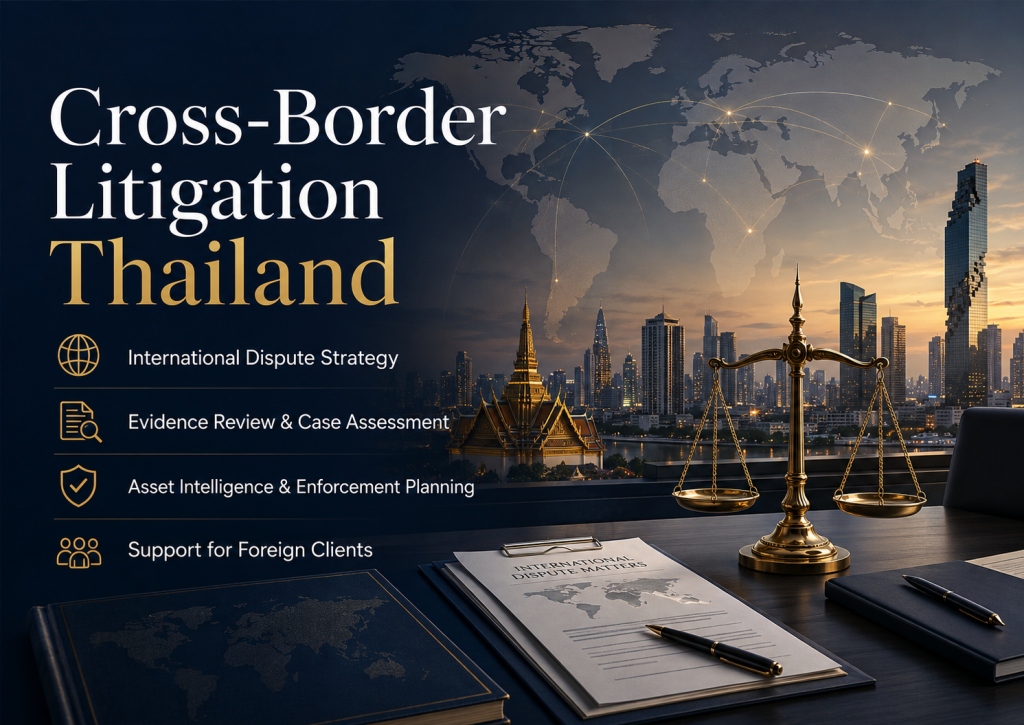
Cross-Border Litigation in Thailand for Foreign Clients
Cross-border disputes usually involve more practical complexity than purely domestic litigation. A foreign client may have a contract signed overseas, payments made through international bank accounts, communications across several jurisdictions, a Thai debtor, Thai assets, or a counterparty who operates through nominees, related companies, or informal business structures. In these cases, you must address both the Thai litigation process and the wider international context.
At Skyinterlegal, we help clients assess whether:
- the dispute can be brought before a Thai court;
- Thai law, foreign law, or contractual governing law may affect the claim;
- the available evidence is sufficient for legal action;
- the opponent has identifiable assets or business interests in Thailand;
- settlement, litigation, criminal complaint support, or enforcement planning may be appropriate; and
- pursuing the case in Thailand is commercially reasonable.
This practical assessment helps clients avoid unnecessary legal costs and focus on claims with realistic recovery potential.
When cross-border litigation in Thailand may be necessary?
Cross-border litigation may become necessary when a dispute involves foreign parties, international transactions, Thai-based assets, or legal obligations connected to Thailand. Common situations include:
- A foreign company has not been paid by a Thai company;
- A Thai supplier fails to deliver goods or services under an international contract;
- A foreign investor faces a shareholder or company control dispute in Thailand;
- A foreign creditor needs to pursue a Thai debtor;
- A business partner in Thailand refuses to return funds or assets;
- A fraud scheme involves Thai bank accounts, Thai companies, or Thai-based individuals;
- A contract dispute involves foreign payments and Thai performance obligations;
- A foreign judgment or award requires enforcement strategy in Thailand;
- A debtor moves assets into Thailand or uses Thai nominees; and
- A dispute requires evidence collection, asset tracing, or witness location in Thailand.
In many cross-border cases, the legal claim and the recovery strategy must be developed together from the beginning.
Types of Cross-Border Litigation Cases in Thailand We Handle
At Skyinterlegal, we support foreign clients in a wide range of Thailand-related cross-border disputes, including
1. International contract disputes
International contract disputes may involve foreign buyers, Thai suppliers, distributors, service providers, manufacturers, technology providers, consultants, or joint venture partners.
These disputes often arise from:
- Breach of contract;
- Non-payment under commercial agreements;
- Failure to deliver goods or services;
- Defective performance;
- Termination disputes;
- Misrepresentation before contract signing; and
- Disputes over governing law, jurisdiction, or dispute resolution clauses.
For related support, clients may also review our page on Contract Dispute Thailand.
2. Cross-border debt claims
Foreign creditors often face difficulties when a Thai debtor refuses to pay an invoice, loan, settlement amount, or commercial debt. The debtor may delay payment, dispute liability, change company structures, move assets, or claim financial difficulty.
We can assist you with:
- Debt claim assessment;
- Demand letter strategy;
- Debtor background checks;
- Asset investigation;
- Litigation preparation;
- Settlement negotiation; and
- Judgment enforcement planning.
For more specific debt-related matters, please see our pages on Debt Recovery Litigation Thailand and Debt Collection and Asset Recovery Services in Thailand.
3. Cross-border fraud litigation
Fraud-related disputes can become more complex when funds, victims, suspects, companies, bank accounts, or evidence are located in different countries. Foreign victims may need to preserve evidence quickly and assess whether civil claims, criminal complaint support, settlement strategy, or asset recovery planning should be pursued in Thailand.
We assist with matters involving:
- Investment fraud;
- Business fraud;
- Invoice fraud;
- Misrepresentation;
- Forgery or false documents;
- Misappropriation of funds;
- Asset concealment;
- Thai bank account or company involvement; and
- Cross-border recovery planning.
For fraud case support, please see our page on Fraud Litigation Thailand.
4. Shareholder and investor disputes
Foreign investors in Thai companies may face disputes involving company control, director authority, nominee shareholders, document access, profit distribution, unauthorized transactions, or misuse of company assets.
These disputes often require both legal and investigative analysis because the real issue may involve control of company records, ownership trail, bank movements, or business assets.
We assist foreign shareholders and investors with case assessment, evidence review, litigation strategy, and asset intelligence support.
For related services, please see our page on Shareholder Disputes Thailand.
5. Commercial litigation involving Thai companies
Cross-border commercial litigation may involve importers, exporters, distributors, manufacturers, contractors, SaaS providers, online businesses, investors, lenders, and international service providers. Before filing a case, foreign clients should understand whether the Thai counterparty has assets, ongoing operations, real business activity, or enforceable value.
For broader commercial disputes, please see our page on Commercial Litigation in Thailand.
Key Challenges in Cross-Border Litigation Thailand
Cross-border litigation often fails or becomes inefficient when clients focus only on the legal claim and overlook evidence, jurisdiction, debtor behavior, and enforcement.
1. Evidence
Evidence may include contracts, emails, invoices, chat messages, bank transfers, shipping documents, company records, witness statements, or foreign-language documents. Some evidence may require translation, certification, or careful organization before use in Thailand.
At Skyinterlegal, we can help clients review and structure evidence so the legal team can understand the claim clearly and prepare a practical case strategy.
2. Jurisdiction and governing law
International contracts may contain governing law clauses, jurisdiction clauses, arbitration clauses, or dispute resolution provisions. These clauses may affect whether a dispute should proceed in Thailand, overseas, or through arbitration. A proper legal review can help determine whether Thai litigation is appropriate or whether another procedure may offer a better strategic route.
3. Difficulty locating debtors, assets, or witnesses
In many cross-border cases, the opponent may be difficult to locate or may use incomplete addresses, nominee structures, related companies, or informal business arrangements.
At Skyinterlegal, our investigation background allows us to support litigation strategy through:
- Debtor location checks;
- Company background checks;
- Business operation verification;
- Asset search;
- Witness location support; and
- Ownership and control analysis.
For asset-related support, please see Asset Search in Thailand and Thailand Investigation Services.
4. Enforcement Risk in Cross-Border Litigation Thailand
A judgment has limited commercial value if the debtor has no reachable assets or if enforcement has not been planned properly. Foreign clients should assess enforcement risk before spending substantial time and legal costs.
At Skyinterlegal, we help clients consider enforcement planning from the beginning, including asset visibility, debtor behavior, business operations, property interests, shareholdings, bank account indicators, and recovery strategy.
For related enforcement support, please see our page on Enforcement of Judgments and Asset Investigation in Thailand.
Our Cross-Border Litigation Strategy
At Skyinterlegal, we use a structured approach to cross-border litigation in Thailand. Our objective is to help clients understand the legal, evidential, commercial, and enforcement risks before taking major action. Our steps generally include:
1. Case assessment
We review the dispute background, parties, contracts, communications, payment records, governing law clauses, jurisdiction issues, and available evidence. This helps identify the legal nature of the claim and whether Thai litigation may be appropriate.
2. Evidence review and case structuring
We organize key evidence and identify missing documents or factual gaps. In cross-border disputes, clear evidence presentation is critical because facts may be spread across different jurisdictions, languages, companies, and communication channels.
3. Opponent and asset intelligence
Before litigation or settlement negotiation, we may help assess the opponent’s background, business activity, assets, company interests, or enforcement exposure in Thailand. This step can help determine whether the claim is commercially worth pursuing.
4. Pre-litigation strategy
In some cases, a demand letter, settlement proposal, or negotiation strategy may produce a faster and more cost-effective outcome. In other cases, immediate legal action may be necessary to preserve rights or increase pressure.
5. Litigation support
When litigation becomes necessary, we assist with Thai legal coordination, claim preparation, evidence organization, procedural support, and communication with the client or overseas counsel.
Our role may include supporting Thai proceedings, coordinating with foreign law firms, preparing factual summaries, and aligning litigation with recovery objectives.
6. Enforcement and recovery planning
A cross-border litigation strategy should not end with a judgment. We help clients plan the next stage by assessing enforcement options, debtor assets, settlement leverage, and practical recovery routes in Thailand.
Working with Foreign Law Firms and Overseas Counsel
At Skyinterlegal, we also support foreign law firms, in-house legal teams, and overseas counsel in Thailand-related disputes. We understand that cross-border litigation often requires coordination between legal teams in different jurisdictions.
We can assist with:
- Thailand-based factual investigation;
- Local evidence review;
- Debtor or asset checks;
- Company and ownership verification;
- Litigation support;
- Settlement coordination;
- Enforcement planning; and
- Communication with relevant parties in Thailand.
This support can help overseas counsel understand the Thai side of the dispute and develop a practical litigation or recovery strategy.
Why Choose Us
Cross-border litigation requires legal analysis, but it also requires practical intelligence. A claim may look strong on paper, but recovery depends on evidence, assets, debtor behavior, and enforcement feasibility.
At Skyinterlegal, we combine legal support with investigation-led strategy. Our background in private investigation gives us a practical advantage in evidence gathering, asset discovery, company verification, debtor tracing, and enforcement planning.
Clients choose us for:
- Experience supporting foreign clients in Thailand-related disputes;
- Investigation-led litigation strategy;
- Asset intelligence before and during litigation;
- Practical case assessment before legal costs escalate;
- Support for civil, commercial, and criminal disputes;
- Coordination with foreign law firms and overseas counsel; and
- Clear communication for international clients.
Our goal is to help clients pursue disputes in Thailand with legal precision, commercial realism, and recovery-focused planning.
Contact Us
If you are involved in an international dispute connected to Thailand, Skyinterlegal can help you assess your legal position, evidence, opponent profile, asset visibility, and enforcement strategy.
Contact us today for professional support with Cross-Border Litigation Thailand, including international contract disputes, debt claims, fraud cases, shareholder conflicts, evidence review, asset investigation, and enforcement planning.

FAQ on Cross-Border Litigation Thailand
What is cross-border litigation in Thailand?
Cross-border litigation in Thailand refers to legal disputes involving Thailand and at least one foreign element. This may include foreign parties, international contracts, overseas payments, Thai debtors, Thai assets, foreign evidence, or enforcement issues connected to Thailand.
Can a foreign company sue a Thai company in Thailand?
Yes, a foreign company may be able to sue a Thai company in Thailand if the Thai court has jurisdiction and the claim has a valid legal basis. The specific strategy depends on the contract, evidence, parties, governing law, and dispute facts.
Should I investigate a Thai debtor before filing a lawsuit?
Yes, in many cases, it is sensible to conduct debtor and asset checks before filing a lawsuit. This helps determine whether the debtor has assets, business operations, or recovery potential in Thailand.
Can you help with evidence in Thailand?
Yes, at Skyinterlegal, we can assist with evidence review, factual investigation, company checks, asset search, debtor location, witness location support, and litigation preparation for Thailand-related disputes.
What types of cross-border disputes do you support?
At Skyinterlegal, we support wide-range of cross-border disputes including, contract disputes, commercial litigation, debt claims, fraud-related claims, shareholder disputes, investor disputes, criminal disputes, asset recovery matters, and enforcement-related disputes connected to Thailand.
Is settlement possible before filing a lawsuit in Thailand?
Yes, settlement may be possible before litigation if the opponent has commercial motivation to resolve the dispute. A well-prepared demand letter, evidence package, and asset intelligence strategy can improve negotiation leverage.
Why is enforcement planning important in cross-border litigation?
Enforcement planning is important because a court judgment does not automatically result in recovery. Clients should assess whether the debtor has reachable assets and whether enforcement in Thailand is practical before spending significant legal costs.
Can you work with my overseas lawyer?
Yes, at Skyinterlegal, we can support foreign law firms, overseas counsel, and in-house legal teams that require Thailand-based legal support, investigation assistance, asset checks, evidence review, or enforcement planning.
For more inquiries, please feel free to contact us:
Sky International Legal Co., Ltd.
725 S Metro Building, 20th Floor, Room 174, Sukhumvit Road, Khlong Tan Nuea Subdistrict, Vadhana District, Bangkok 10110.
See map (click here)
Tel. 081-9151522, 090-0700080
Email: skyinterlegal@gmail.com