

Property Litigation in Thailand
Property Litigation Thailand requires careful legal, factual, and asset-based analysis. Real estate disputes in Thailand often involve ownership documents, sale and purchase agreements, lease structures, nominee concerns, company shareholding, investment arrangements, fraud allegations, possession issues, and enforcement risks.
For foreign clients, property litigation is not only about proving a legal claim. It is also about understanding whether the property, debtor, seller, developer, company, or opposing party has recoverable value in Thailand.
At Skyinterlegal, we assist foreign individuals, investors, creditors, landlords, tenants, developers, business partners, and overseas counsel with property litigation and real estate disputes in Thailand. Our approach combines legal strategy, document review, investigation support, asset intelligence, and enforcement planning.
We help clients assess the strength of their claim, preserve evidence, identify practical risks, and develop a recovery-focused litigation strategy.
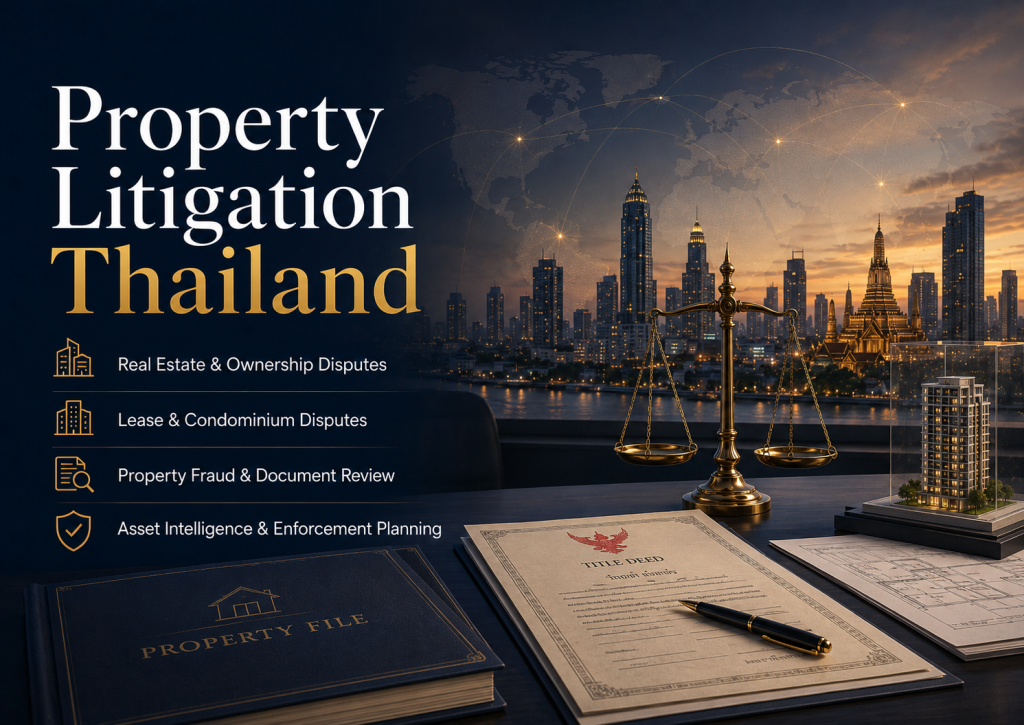
Property Litigation Thailand for Foreign Clients
Foreign clients may face unique risks when property disputes arise in Thailand. These risks often involve language barriers, unfamiliar land documents, nominee arrangements, informal agreements, unclear payment records, or reliance on local representatives.
Some clients discover problems only after they have already transferred funds, signed documents, invested in a property project, leased land, entered a joint venture, or allowed another person to hold property-related interests on their behalf.
At Skyinterlegal, we help foreign clients assess whether:
- a valid legal claim exists;
- the property documents support the claim;
- the opposing party has legal title, possession, or control;
- fraud, misrepresentation, or breach of contract may be involved;
- the dispute should proceed through negotiation, litigation, criminal complaint support, or enforcement planning; and
- the opposing party has assets or recoverable value in Thailand.
This early assessment helps clients avoid unnecessary legal costs and focus on a practical strategy.
Common Property Disputes in Thailand
Property disputes in Thailand can arise from residential, commercial, investment, leasehold, inheritance, development, or company-related arrangements.
Common property disputes in Thailand may include:
- Condominium purchase disputes;
- Land purchase and investment disputes;
- Lease disputes;
- Breach of real estate sale agreements;
- Developer disputes;
- Property fraud and misrepresentation;
- Disputes involving deposits or advance payments;
- Property-related debt claims;
- Enforcement against real estate assets; and
- Disputes involving foreign buyers or foreign investors.
In many cases, property litigation overlaps with contract disputes, fraud claims, shareholder disputes, debt recovery, and asset investigation.
1. Condominium disputes in Thailand
Condominium disputes are common among foreign buyers because condominiums are one of the most accessible property structures for foreign nationals in Thailand. However, disputes may still arise over ownership transfer, payment obligations, foreign quota issues, construction delays, defects, misrepresentation, management fees, or failure to deliver title.
Common condominium disputes include:
- Failure to transfer ownership;
- Delay in project completion;
- Defective construction or poor handover condition;
- Misrepresentation by seller, agent, or developer;
- Disputes over deposits or installment payments;
- Foreign quota and transfer-related problems;
- Unclear ownership documents;
- Breach of sale and purchase agreement;
- Disputes with juristic person management; and
- Resale or cancellation disputes.
2. Land and ownership disputes
Land disputes can be more complex for foreign clients because Thai law generally restricts direct foreign land ownership, subject to limited exceptions and specific legal structures. Foreigners commonly use leasehold arrangements, company structures, investment structures, or other contractual rights when land is involved. These structures require careful legal review because improper arrangements may create serious litigation and recovery risks.
Land-related disputes may involve:
- Ownership claims;
- Boundary disputes;
- Possession disputes;
- Land lease disputes;
- Disputes over land sale agreements;
- Land investment arrangements;
- Property held through Thai companies;
- Unauthorized transfer or mortgage;
- Disputes involving family members, business partners, or representatives; and
- Fraudulent land transactions.
At Skyinterlegal, we can help clients review the factual and documentary background before deciding whether litigation, negotiation, investigation, or enforcement action is appropriate.
3. Lease disputes in Thailand
Lease disputes may involve residential property, commercial premises, land leases, villas, hotels, offices, factories, warehouses, or long-term investment arrangements. Common lease disputes include:
- Non-payment of rent;
- Early termination;
- Breach of lease obligations;
- Failure to return deposit;
- Unauthorized sublease;
- Failure to maintain property;
- Disputes over renewal rights;
- Disputes over long-term land lease arrangements;
- Eviction and possession issues;
- Damage to property; and
- Disputes between foreign tenants and Thai landlords.
Lease litigation requires careful review of the lease agreement, payment records, termination notice, property condition evidence, correspondence, and possession status.
4. Property fraud and misrepresentation
Property disputes may involve fraud or misrepresentation when a seller, agent, developer, business partner, nominee, or representative provides false information or conceals important facts.
Examples include:
- False promise to transfer property;
- Misrepresentation about ownership;
- Misrepresentation about land title or development rights;
- Sale of property without proper authority;
- Fake investment structure;
- Misuse of buyer funds;
- Forged documents;
- Concealment of mortgage, encumbrance, or third-party rights; and
- Misleading statements about project approval or completion.
In these cases, clients may need both civil litigation strategy and criminal complaint support. Evidence preservation is especially important in this case because it may determine the strength of the claim.
For related support, clients may also review Fraud Litigation Thailand.
5. Property disputes involving companies and shareholders
Many real estate disputes in Thailand involve companies that hold land, operate property projects, manage investments, or control property-related assets. These disputes may arise between:
-
- Foreign investors and Thai shareholders;
- Directors and shareholders;
- Business partners;
- Joint venture parties;
- Nominee shareholders;
- Property developers and investors;
- Lenders and property-holding companies; and
- Family-owned companies and foreign partners.
The dispute may involve ownership control, company documents, director authority, unauthorized asset transfers, misuse of company property, profit distribution, or attempts to move property away from creditors or investors.
For related company-control disputes, please see Shareholder Disputes Thailand.
Property Litigation and Asset Recovery
Property litigation often connects directly with asset recovery, particularly where property has been transferred, concealed, misused, or placed beyond the reach of rightful owners, investors, or creditors. In Thailand, disputes involving land, real estate, or company-owned property frequently involve broader issues, such as nominee arrangements, hidden ownership, unauthorized transfers, fraud, or misuse of assets.
What may appear to be a straightforward property dispute can require detailed investigation into ownership structures, financial transactions, corporate records, and connected parties. Early action is often critical to preserve evidence, trace assets, and prevent further transfers.
Our investigation background helps clients assess these practical issues before legal costs escalate. For related support, clients may review Asset Search in Thailand and Enforcement of Judgments and Asset Investigation in Thailand.
Our Property Litigation Strategy in Thailand
At Skyinterlegal, we use a structured and recovery-focused approach to property litigation in Thailand. Our steps may include:
1. Initial case assessment
We review the dispute background, parties, property type, transaction documents, payment records, communications, and client objectives. This helps identify the legal nature of the dispute and the practical risks involved.
2. Property Document Review for Thailand Litigation
We review relevant documents, such as sale agreements, lease agreements, title documents, transfer records, company documents, receipts, bank transfers, powers of attorney, correspondence, and evidence of possession or use.
3. Opponent and asset intelligence
Before litigation, we may assess the opposing party’s profile, business activity, property interests, company connections, related parties, and potential assets. This helps determine whether litigation is commercially reasonable.
4. Evidence preservation
Property disputes often depend on documentary evidence. We help clients identify key evidence, organize documents, preserve communications, and prepare factual summaries for legal strategy.
5. Negotiation or pre-litigation action
Some property disputes may be resolved through demand letters, negotiation, settlement proposals, or structured mediation. This may reduce cost and preserve commercial value where the opposing party is willing to cooperate.
6. Litigation support
When court action becomes necessary, we provide support for Thai litigation, evidence preparation, factual analysis, litigation strategy, and communication with the client or overseas counsel.
7. Judgment enforcement and recovery planning
If the client obtains a judgment, the next stage may involve enforcement against property, bank accounts, company shares, receivables, or other debtor assets. We help clients plan enforcement based on asset visibility and practical recovery options.
Why evidence matters in property litigation Thailand?
Property litigation is evidence-driven. A client may have a strong complaint, but the outcome often depends on whether the documents and facts can prove the claim.
Important evidence may include:
- Sale and purchase agreements;
- Lease agreements;
- Title documents;
- Transfer records;
- Marketing materials;
- Developer representations; and
- Photographs and inspection records.
Early evidence review helps avoid weak filings and supports stronger negotiation or litigation strategy.
Working with Foreign Buyers, Investors, and Overseas Counsel
At Skyinterlegal, we regularly support foreign buyers, investors, and international stakeholders involved in disputes, investigations, and asset-related matters in Thailand. Our firm is experienced in working alongside overseas counsel, providing local intelligence, factual investigation, strategic support, and clear reporting to assist cross-border legal and commercial matters.
We understand the importance of professional English communication, coordinated case management, and timely information sharing when acting in support of international legal teams. Our work is designed to complement overseas counsel by helping clients navigate local structures, evidence issues, asset tracing, and Thailand-based dispute risks efficiently and discreetly.
Thus, we may assist you with:
- Thailand-based property dispute review;
- Local document and factual checks;
- Property-related investigation;
- Debtor and asset checks;
- Coordination with Thai counsel;
- Settlement and litigation strategy;
- Enforcement planning; and
- Communication with foreign clients and overseas legal teams.
This support is especially useful where the client needs reliable local assistance before deciding whether to pursue legal action.
Why Choose Us
Property litigation in Thailand often requires more than legal drafting. It requires factual investigation, document review, asset intelligence, and practical recovery planning. At Skyinterlegal, we combine legal support with an investigation-led approach. Our background in private investigation gives us a practical advantage in property-related disputes involving hidden assets, nominee concerns, debtor behavior, company ownership, fraudulent transactions, and enforcement risks.
Clients choose us for:
- Experience supporting foreign clients in Thailand-related disputes;
- Investigation-led litigation strategy;
- Property document and evidence review;
- Asset search and debtor intelligence;
- Support for fraud-related property disputes;
- Coordination with overseas counsel;
- Clear communication for foreign clients; and
- Recovery-focused planning from the beginning.
Our objective is to help clients pursue property disputes in Thailand with legal precision, commercial realism, and enforcement readiness.
Contact Us
If you are involved in a real estate or property dispute in Thailand, Skyinterlegal can help you assess your legal position, evidence, property documents, opponent profile, asset visibility, and recovery strategy.
Contact us today for professional support with Property Litigation Thailand, including real estate disputes, condominium disputes, land and lease disputes, property fraud claims, asset investigation, and enforcement planning for foreign clients.

FAQ on Property Litigation Thailand
What is property litigation in Thailand?
Property litigation in Thailand refers to legal disputes involving real estate, land, condominiums, leases, ownership claims, possession, property contracts, developer disputes, fraud claims, and enforcement against property assets.
Can foreigners file property lawsuits in Thailand?
Yes, foreign individuals and companies may be able to bring property-related claims in Thailand if there is a valid legal basis and the Thai court has jurisdiction over the dispute.
What are common property disputes involving foreign clients in Thailand?
Common disputes include condominium purchase problems, land investment disputes, lease disputes, developer disputes, fraud claims, nominee issues, ownership disputes, deposit disputes, and property-related debt claims.
Can a foreigner own property in Thailand?
Foreigners may generally own condominium units if legal requirements are met. Direct land ownership by foreigners is generally restricted, subject to limited exceptions and specific legal structures. Each case requires careful legal review.
Should I investigate the opposing party before filing a property lawsuit?
Yes, investigation can help determine whether the opposing party owns assets, controls a company, operates a business, or has recoverable value in Thailand. This is especially important before spending substantial litigation costs.
Can property fraud be handled through litigation in Thailand?
Yes, property fraud may involve civil claims for damages, cancellation, recovery of funds, or other remedies. In some cases, criminal complaint support may also be appropriate depending on the facts and evidence.
What kind of evidence that is considered important in property litigation?
Important evidence may include contracts, title documents, payment records, transfer documents, receipts, emails, chat messages, photographs, company documents, powers of attorney, witness details, and evidence of fraud or possession.
Can you assist foreign clients who are outside Thailand?
Yes, at Skyinterlegal, we can assist foreign clients remotely by reviewing documents, coordinating local investigation, communicating with Thai legal professionals, and helping develop a litigation and recovery strategy.
Is settlement possible in property disputes?
Yes, settlement may be possible where the opposing party has commercial motivation to resolve the dispute. A strong evidence file and asset intelligence can improve negotiation leverage.
For more inquiries, please feel free to contact us:
Sky International Legal Co., Ltd.
725 S Metro Building, 20th Floor, Room 174, Sukhumvit Road, Khlong Tan Nuea Subdistrict, Vadhana District, Bangkok 10110.
See map (click here)
Tel. 081-9151522, 090-0700080
Email: skyinterlegal@gmail.com